Tungsten, hydrogen, and the limits of today’s quantum computers.

A VQE proof-of-concept that runs the full quantum-chemistry pipeline on real tungsten chemistry — on real IBM Quantum hardware — then measures exactly how far today’s machines are from trustworthy chemistry.

3 notebooks 3 real QPU runs MIT licensed Research prototype
Read the story Jump to the verdict

Why this matters

A fusion reactor traps tritium in its own walls.

ITER, DEMO, and every other deuterium–tritium fusion design lines its inner wall with tungsten — the metal with the highest melting point. Hot plasma slams hydrogen and its radioactive isotope tritium into that wall, and some of it gets stuck in microscopic lattice defects.

That trapped tritium is a safety, supply, and licensing problem: it is radioactive, expensive to produce, and regulated. For every reactor design, engineers need one number — how strongly does tritium bind to a tungsten vacancy? That binding energy is just the energy of the trapped atom minus the energy of the free atom. Compute both, subtract.
Plasma in

Millions of degrees. Hydrogen and tritium bombard the tungsten wall continuously.

Tritium trapped

Atoms lodge in vacancy defects in the tungsten crystal — a growing radioactive inventory.

The catch

Predicting the binding energy means computing the energy of electrons around tungsten — one of the hardest problems in computational science.

The number that breaks classical computers

Tungsten has 74 electrons. They will not fit.

The electrons all repel each other and must stay quantum-mechanically out of each other’s way. The wavefunction of an N-electron system lives in a space of size roughly 2N. For H2 that is trivial. For tungsten it is 274 — about 1022 numbers.

That is more than the number of stars in the observable universe. You cannot store that on any classical computer, ever. Approximate methods (Hartree–Fock, DFT) cope for most chemistry, but break down exactly where transition metals like tungsten live: strong electron correlation.

0
electrons in one tungsten atom
1022
amplitudes in its wavefunction
0
electrons in H2 (the easy case)
0
classical computers that can store 1022 numbers

The algorithm

VQE lets the quantum computer hold the wavefunction.

A quantum computer with N qubits already is a 2N-dimensional state space — it stores wavefunctions natively, for free. The Variational Quantum Eigensolver is the workhorse that uses this for chemistry.

Classical optimizer scipy.optimize picks new parameters Quantum computer prepares |ψ(θ)⟩ measures ⟨ψ|H|ψ⟩ θ parameters E energy repeat until the energy stops going down
A hybrid quantum–classical loop. It is “hot or cold,” with the QPU holding the wavefunction.
VQE in one paragraph

Build a parameterised quantum circuit — a recipe that, given a set of knobs, prepares some quantum state. Measure that state’s energy. A classical optimizer nudges the knobs to lower it. Repeat until the energy stops dropping. The lowest energy you reach is your estimate of the ground state.

A learning ladder

Three notebooks, trivial to ambitious.

Each notebook stands alone; together they climb from “hello, quantum” to real tungsten chemistry. Every rung was executed end-to-end on real IBM Quantum hardware.

Notebook 1 · 2 circuit qubits

Bell state

01_hello_quantum.ipynb

Save credentials, build the simplest entangled state, run it on the Aer simulator and then on a real QPU. A counts-based first look at entanglement and noise.

Hardware

Run on ibm_marrakesh (2026-05-27). ~2.7% spurious counts — the first noise signature.

Notebook 2 · 2 circuit qubits

H2 binding

02_h2_binding.ipynb

The canonical VQE chemistry problem. A hardcoded STO-3G Hamiltonian; VQE recovers the exact FCI ground state to ~2.45 nanohartree on the simulator.

Hardware

Single-point validated on ibm_marrakesh. ΔE ≈ +30.6 mHa (no mitigation).

Notebook 3 · 6 circuit qubits

WH binding

03_wh_binding.ipynb

The main event. Tungsten hydride anion via pyscf + qiskit-nature. CAS(4,4) → ParityMapper → EfficientSU2(reps=4), computing a potential-energy curve.

Hardware

Single-point validated on ibm_fez. ΔE ≈ +199.8 mHa (no mitigation).

Scales by parameters, not architecture

The same code, today and in 2029+.

Today — this repo

WH on a NISQ chip

  • 4 active electrons, 4 active orbitals
  • 6 circuit qubits (post Z2 tapering)
  • EfficientSU2 ansatz
  • Aer simulator + single-point QPU
  • → a 3.11 eV well depth (caveat below)
Future — 2029+, FT hardware

A tungsten vacancy cluster

  • 20+ active electrons and orbitals
  • 200+ logical qubits (error-corrected)
  • UCCSD-trotterized or QPE
  • Fault-tolerant QPU
  • → genuine chemical accuracy

What changes between the two is geometry, basis, active space, ansatz, and backend — not the architecture. The validated scaffold is the deliverable.

So… did it work?

Yes — as a workflow proof and a hardware benchmark.

It ran the complete quantum-chemistry pipeline on real tungsten chemistry on real quantum hardware, and measured how far today’s machines are from trustworthy chemistry: the noise exceeds the signal, mitigation helps but overshoots, and chemical accuracy needs error correction.

Noise scales steeply with circuit depth

0%
Bell state spurious counts (1 layer)
0
H2 ΔE, mHa (2 qubits, shallow)
0
WH ΔE, mHa (6 qubits, ~100 gates)
0
WH after ZNE, mHa (overshot the floor)

The key read H2 and WH used the same 4096 shots, yet WH’s error was ~6.5× larger. That ratio tracks circuit depth, not shot count — the fingerprint of systematic gate-error bias, not random noise. On WH, the ~200 mHa noise exceeded the ~110 mHa well depth it was trying to measure.

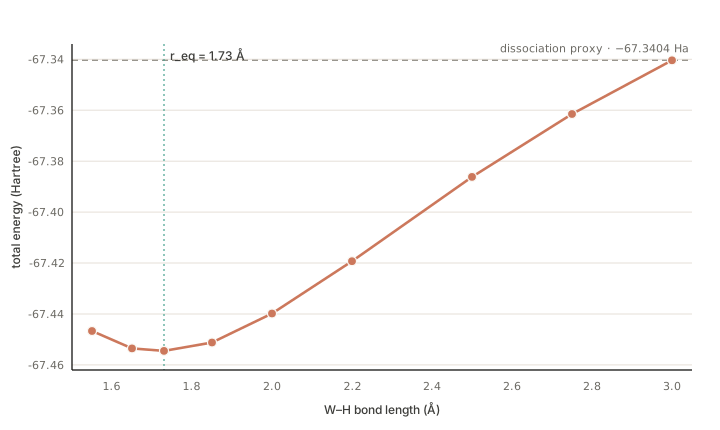
WH-minus potential-energy curve: energy versus bond length, with a single minimum near 1.73 angstrom
The WH potential-energy curve from notebook 03 — a single minimum, repulsive at short range, flattening at long range.

Five things it established

  1. The full VQE-on-real-chemistry pipeline runs end-to-end, and scales by parameters, not architecture.
  2. Noise scales with depth; the 6.5× gap at equal shots is the signature of bias, not shot noise.
  3. On WH, noise (~200) exceeded the signal (~110) — today’s hardware can’t yet see this chemistry.
  4. ZNE halved the error magnitude but overshot the variational floor — magnitude, not reliability.
  5. Chemical accuracy (~1.6 mHa) needs ~100×: a fault-tolerance (2029+) story, not a mitigation-tuning one.
Read the full findings

What this is not.

The discipline of knowing what a number is — and isn’t — is the difference between a research result and a marketing slide. Three things to keep straight:

Not a binding energy

The 3.11 eV “well depth” is for the WH anion, a tractable closed-shell proxy — not the experimental binding energy of neutral WH. Its closeness to literature values is coincidental error cancellation, not physics.

Not quantum advantage

CAS(4,4) is small enough that classical CASCI solves it exactly in milliseconds. This is a workflow demonstration on the smallest meaningful instance, not a classical-beating result.

Not production chemistry

The result is a validated workflow plus a hardware noise benchmark — demonstration-grade at ~7 kcal/mol error, well above chemical accuracy. It was never meant to be a trustworthy tungsten answer.

Where this goes

NISQ today, fault-tolerant tomorrow.

NISQ era early FT fault-tolerant era year → algorithmically useful qubits → 2026 2027 2029 2031+ Bell · H₂ THIS POC — WH⁻ 6q CAS(10,10) multi-W cluster W₈ vacancy + H (logical)
Milestone order and timing — not a literal resource scaling. NISQ markers are circuit qubits; the fusion target is logical (error-corrected) qubits. Different units; the order-of-magnitude jump is what fault tolerance unlocks.
StageQubitsTypeHardwareTimeline
This POC6circuitNISQ sim + single-point QPUToday
Larger basis CAS(6,6)~10circuitNISQ, more QPU minutesToday, paid
Multi-W cluster20–40circuitLate-NISQ + mitigation~2027
W8 vacancy + H200+logicalFault-tolerant QPU2029+

Go deeper

Read the pieces that interest you.